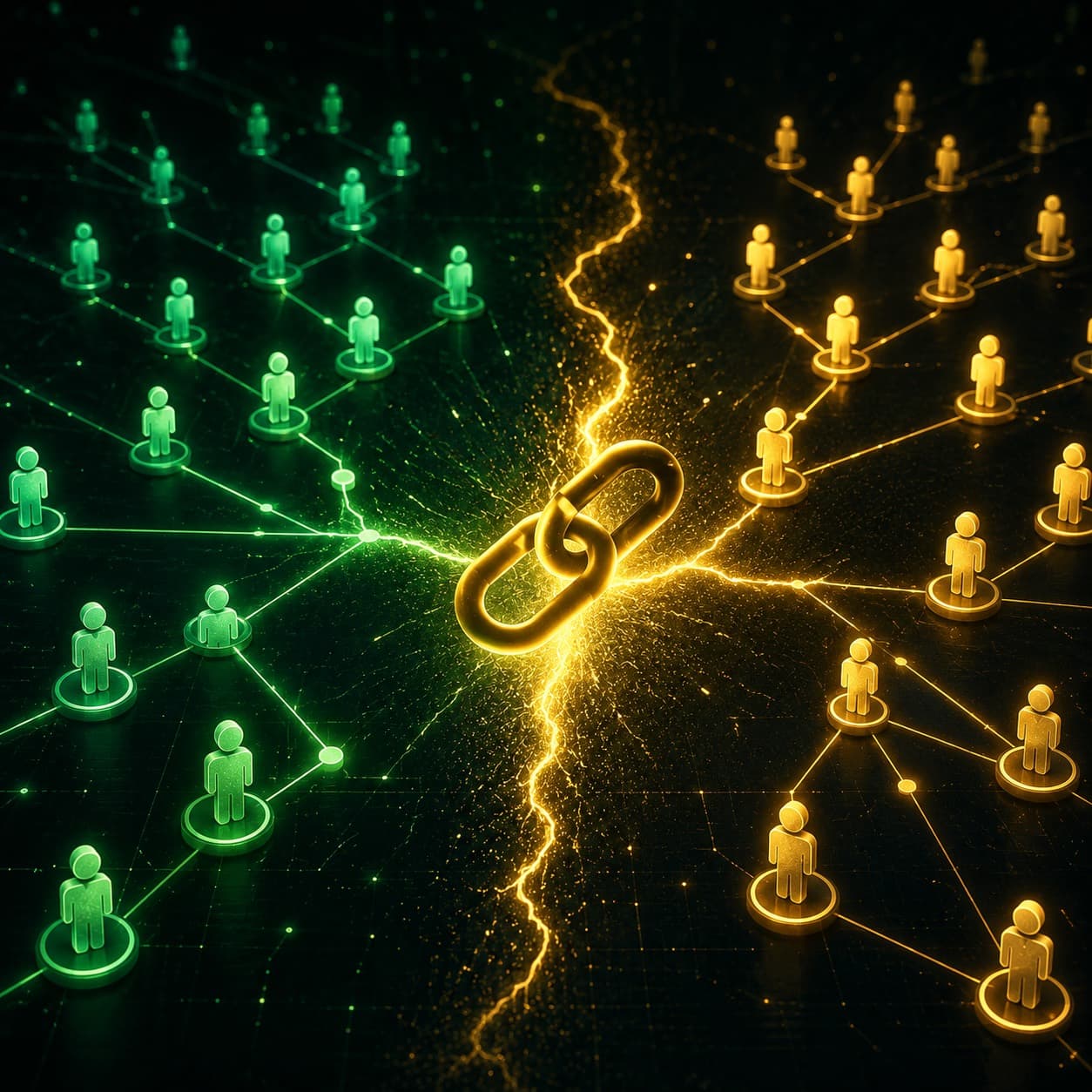
MagnaFork starts from a simple position: the rule is visible before the user decides. The system does not ask for belief in a promised result; it asks the user to check the conditions and assess the risk.
Key idea
MagnaFork does not ask users to trust a promise.
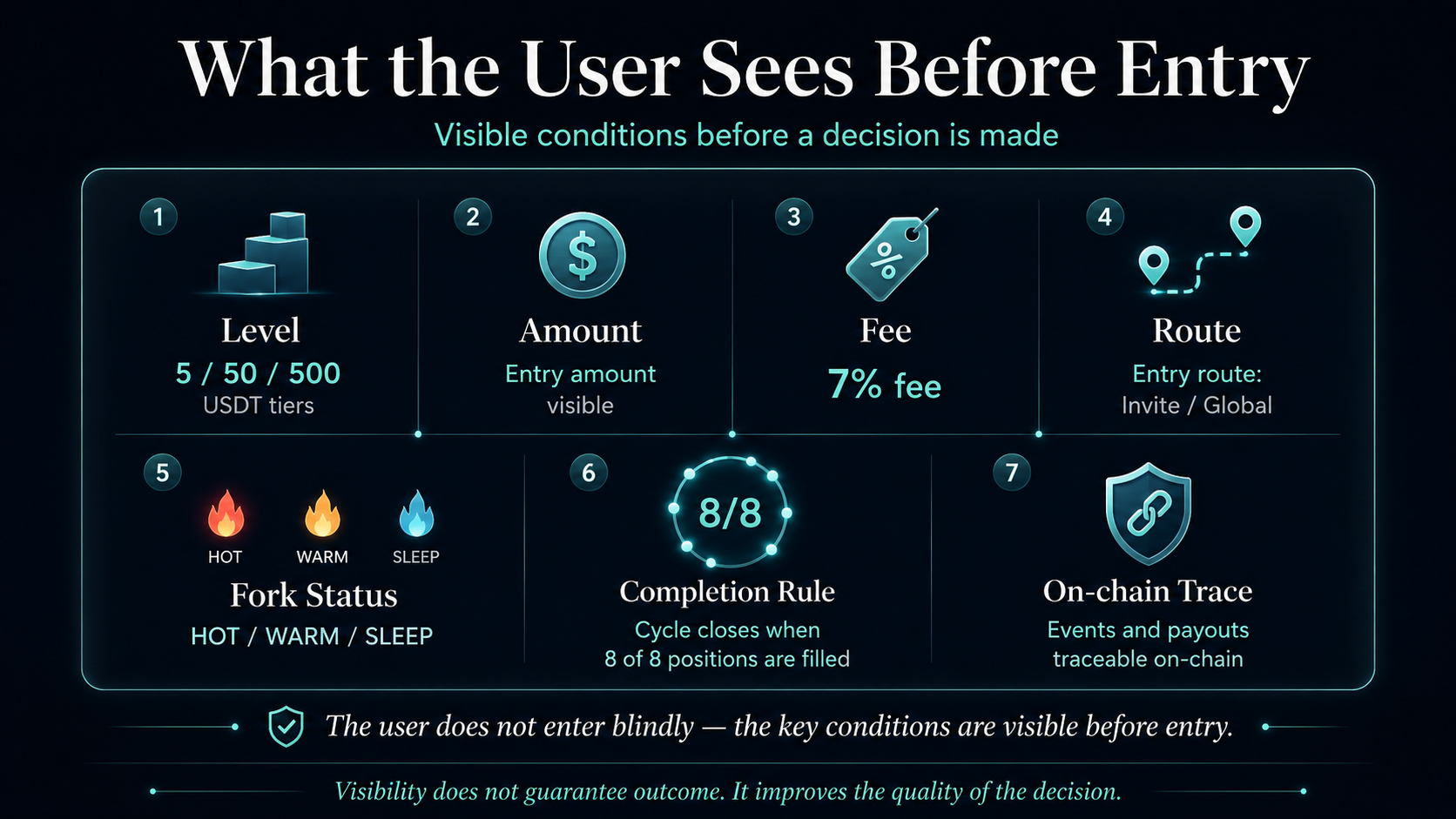
Before entering, the user can see the level, amount, 7% operating fee, route, fork state, 8/8 completion rule, and on-chain trace.
The outcome is not guaranteed.
The rule is visible before the decision is made.
The problem: promises arrive before proof
Many systems ask a person to decide before the mechanics are clear.
A brand asks for trust. A platform asks for trust. A pitch asks for trust. In Web3, even a smart contract can ask for trust if the user cannot understand what the contract does, what the route means, or which condition must happen before a result appears.
For the user, the practical question is simple:
“What exactly am I agreeing to before I confirm?”
MagnaFork is built to answer that question before entry, not after it.
This is the shift behind the phrase “verify the rule, not the promise.” It does not remove risk. It changes the order of the decision: visible conditions first, personal choice after.
Three types of trust
To understand the difference, it helps to compare three models.
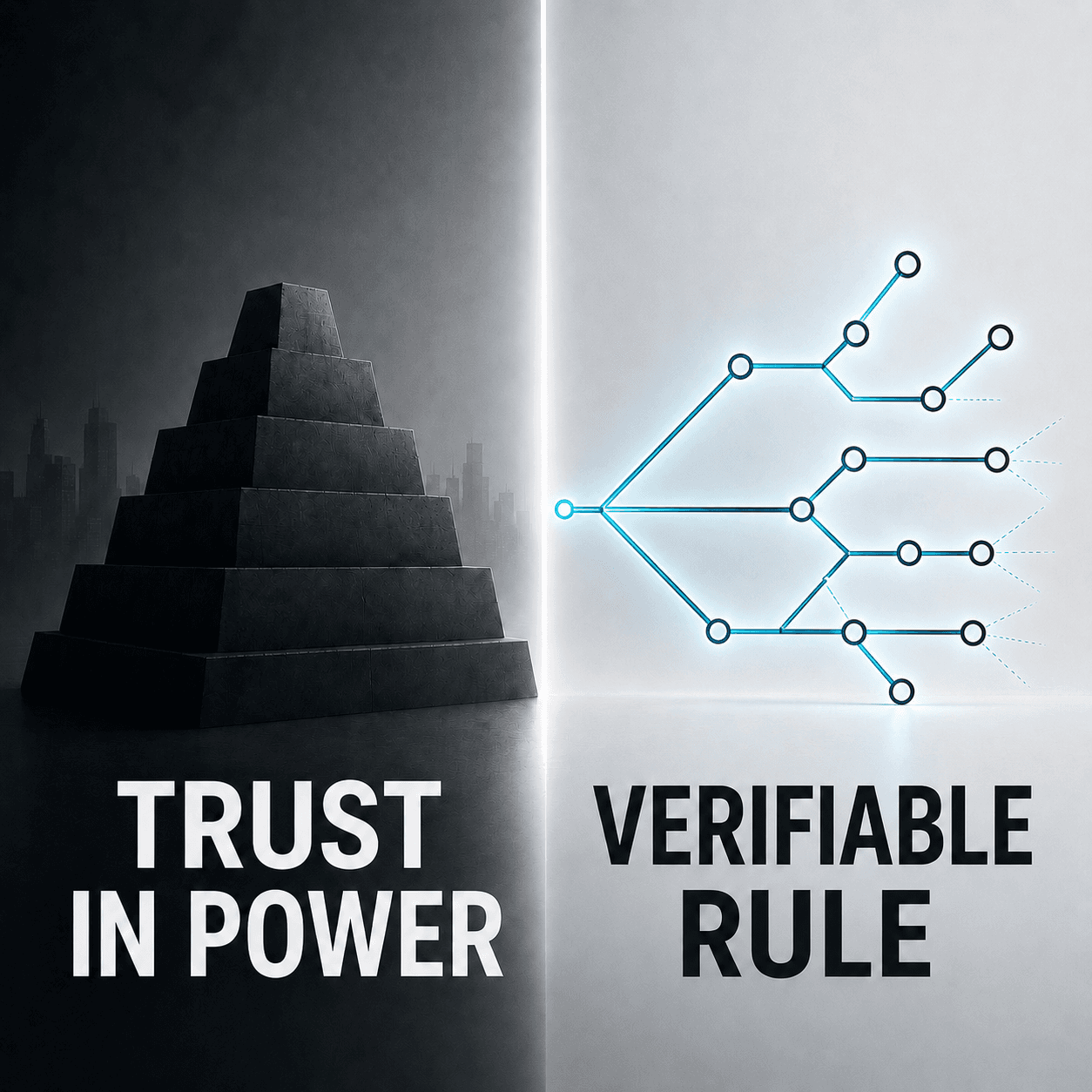
The state is trust in authority. A state has taxes, courts, currency, a debt market, an army, a central bank, and the ability to change rules. When people use state money or buy government obligations, they ultimately trust that large machine to keep functioning.
A pyramid is trust in inflow. The risky part is not the shape of many levels. The risky part is dependency on later participants when standalone value is insufficient and the participant has been sold an expectation of income.
MagnaFork is trust in a verifiable rule. MagnaFork has no state power; it is not stronger than large institutions. Its strength is more concrete: participation conditions can be shown, checked, and compared with on-chain facts.
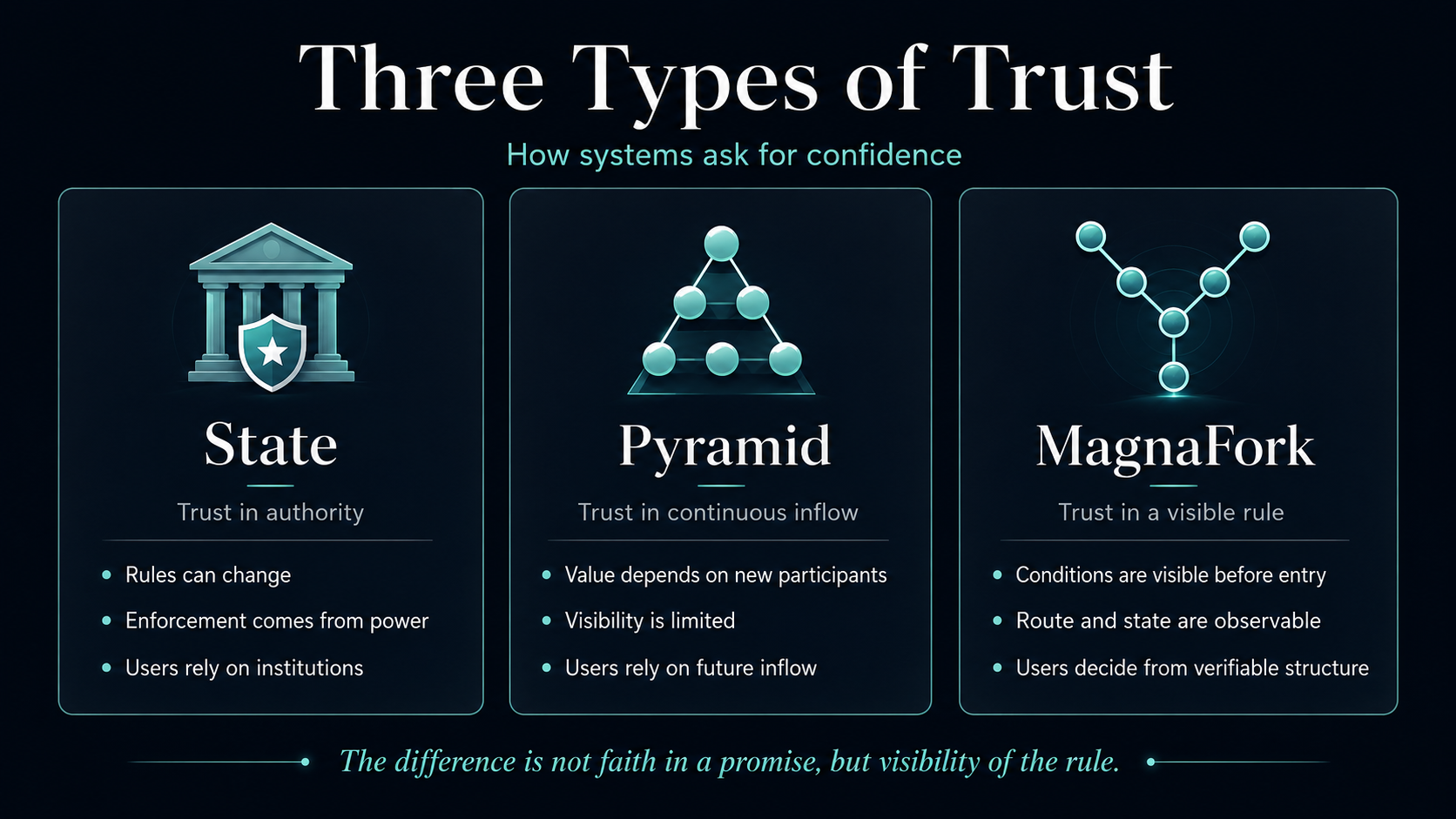
The useful distinction is not a slogan. It is a user question: can I see the source of the result, the rule that triggers it, and the limits before I participate?
What MagnaFork shows before entry
Before entry, the user does not have to guess. The important conditions are visible in one place.
In MagnaFork, this means:
- the participation level:
5 / 50 / 500 USDT; - the selected entry amount;
- the operating fee, known in advance and equal to
7%; - the entry route: invite entry or Open entry;
- the fork state:
HOT / WARM / SLEEP; - the activity window: a fork can move to
SLEEPafter72hours without invite entry; - the completion condition: payout and split execute by the
8/8rule; - the on-chain trace: contract events record entry, fee, position opening,
SLEEP, wake, payout, and split.
This list is the practical center of the MagnaFork explanation.
It is also the practical difference between a promise and a verifiable structure. A promise asks the user to accept a future result. A verifiable structure shows the conditions that must be met before any result can happen.
The user may still decide not to participate. That is part of the design: the decision remains with the user, based on visible rules and personal risk assessment.
Why visibility changes the decision
Visibility does not remove risk. It reduces guesswork at the moment of choice.
Before action, a person can ask:
- Which level am I entering?
- What amount am I sending?
- What part is the
7%operating fee? - Am I entering by invite or through Open entry?
- What is the current fork state?
- What must happen for the
8/8condition to complete? - Which facts can be checked on-chain?
- Can I afford to lose this amount if the cycle does not close?
These questions make participation more conscious. The user is not being asked to believe that a result will appear. The user is being asked to read a visible rule and decide whether the risk is acceptable.
What MagnaFork does not promise
This boundary is stated directly.
MagnaFork is not a product that promises income.
MagnaFork does not guarantee profit. It does not guarantee the speed of cycle completion. It does not remove risk. It does not make the user richer automatically. It does not replace personal assessment of the terms.
Open entry also does not promise a specific fork as a personal entitlement. It follows the contract route and the visible state of the system.
This is not a weakness. It is a necessary boundary.
Strong explanations differ from weak ones not because they promise more, but because they show their limits more precisely. This helps the user understand that the outcome depends on actual activity and that participation is only appropriate with an amount they can afford to lose.
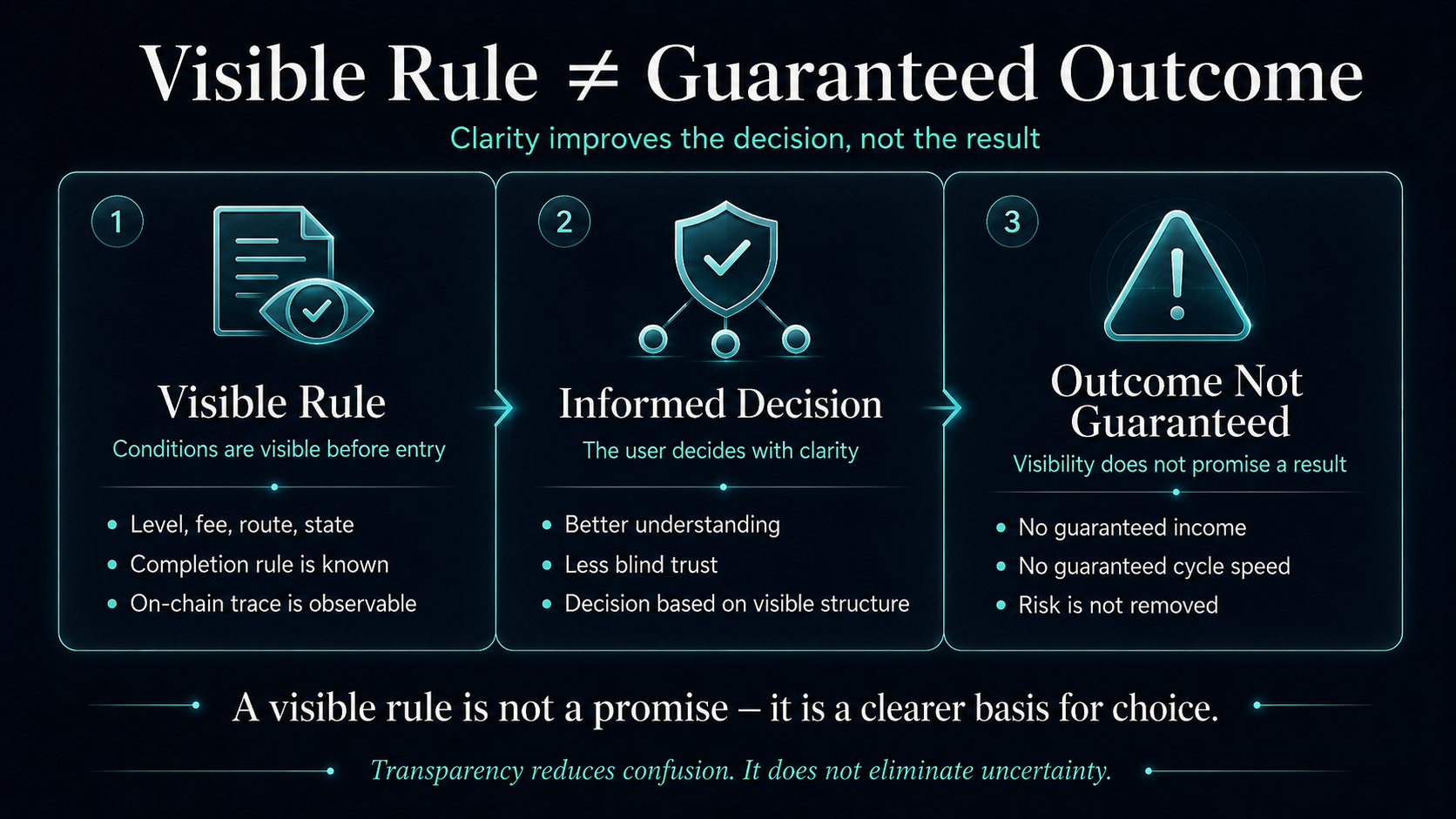
Why transparency alone is not enough
Many projects say: “we are transparent.”
That sentence is not enough.
A smart contract can be open but economically weak. A rule can be visible but risky. A payout can be automatic but depend on conditions that may not happen. A system can be technically honest but badly explained to the user.
So the better question is:
“Can the user understand what happens, where the result comes from, which conditions must be met, and what happens if activity slows down?”
MagnaFork is judged by that standard: not by a promise, not by a label, and not by the mere presence of technology, but by whether the mechanics are readable before the user acts.
The regulatory distinction
Regulators usually look past the name of a project, its packaging, and the presence of technology. They look at the actual mechanics: what the system incentivizes, how the source of the result is structured, and whether recruitment replaces standalone value.
This logic appears in official FTC guidance on MLM, Investor.gov warnings on pyramid schemes, and the European approach to pyramid promotional schemes. The wording differs, but the question is similar: does compensation depend primarily on introducing other consumers rather than on standalone sale, consumption, or product utility?
That is why the careful framing is not “trust us, we are different.”
The careful framing is more concrete:
- show the source of the result;
- show the entry route;
- show the condition for payout and split;
- show the on-chain trace;
- name the risk and the absence of a guaranteed outcome.
Verifiability does not replace legal analysis. It gives the user and any reviewer a clearer factual basis for analysis.
What the user checks
Before participating in MagnaFork, the user does not “believe.” The user checks.
Check the selected level. Check the amount. Check the operating fee. Check the route. Check the current fork state. Check the 8/8 condition. Check what can be verified on-chain. Check whether the amount is acceptable to lose.
If the user participates after that, the participation is based on visible conditions rather than a hidden promise.
This is the standard MagnaFork keeps: the user decides based on rules they can see.
Conclusion: the rule is not a promise
MagnaFork is not a story about blind faith.
It offers a simpler and stricter standard:
- rules are visible before entry;
- risks are named;
- mechanics are verifiable;
- the decision remains with the user.
A visible rule does not say: “you will receive a result.”
It says: “here are the conditions, here is the route, here is the fee, here is the completion rule, here is the on-chain trace, and here are the limits.”
That is the core idea.
MagnaFork is not trust in a promise.
MagnaFork is trust in what can be checked.
Disclaimer
This material is educational and is not financial, investment, or legal advice. Participation in MagnaFork involves risk. Distribution follows the rules of the smart contract, but the speed of level filling and the final outcome are not guaranteed. Participate only with an amount you can afford to lose.