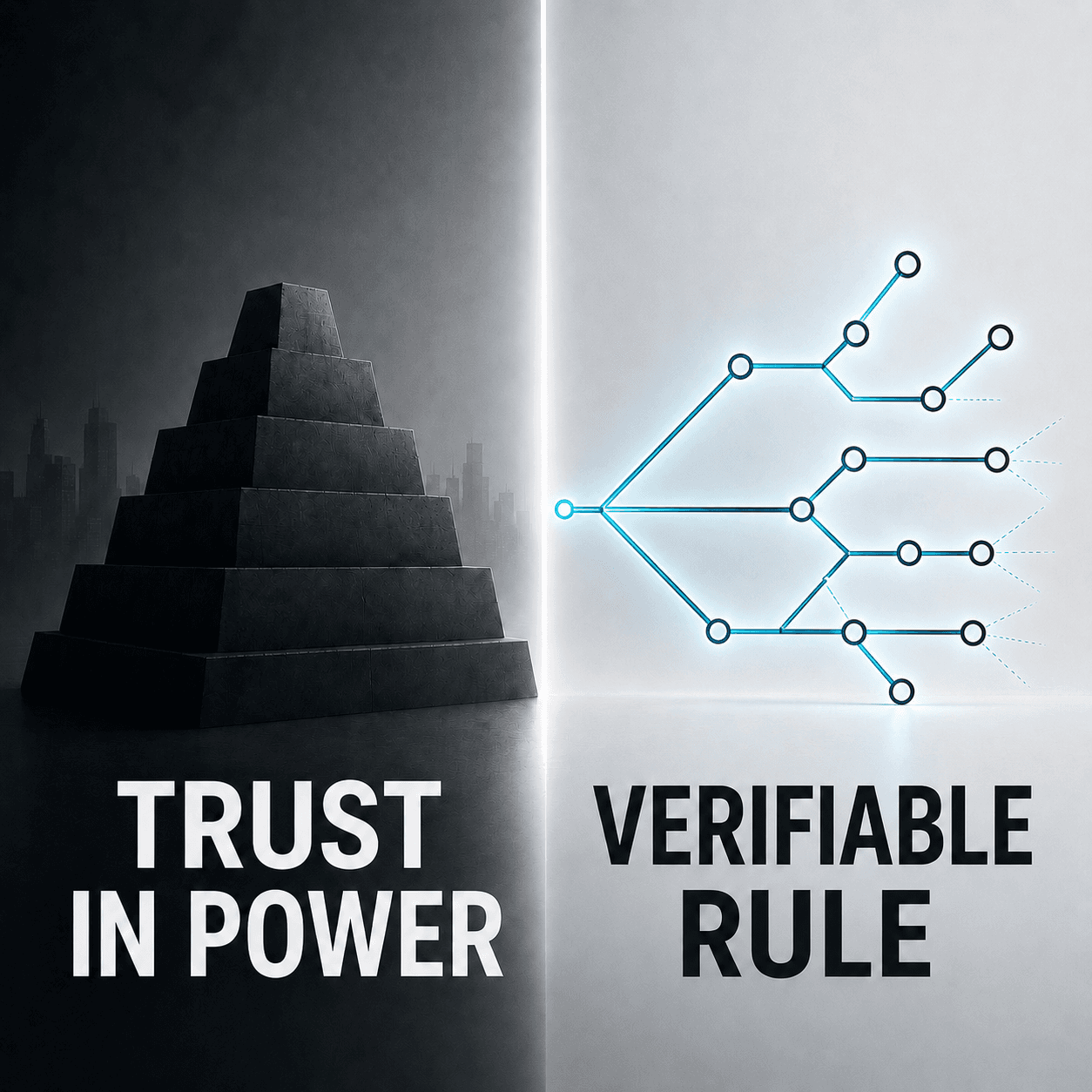
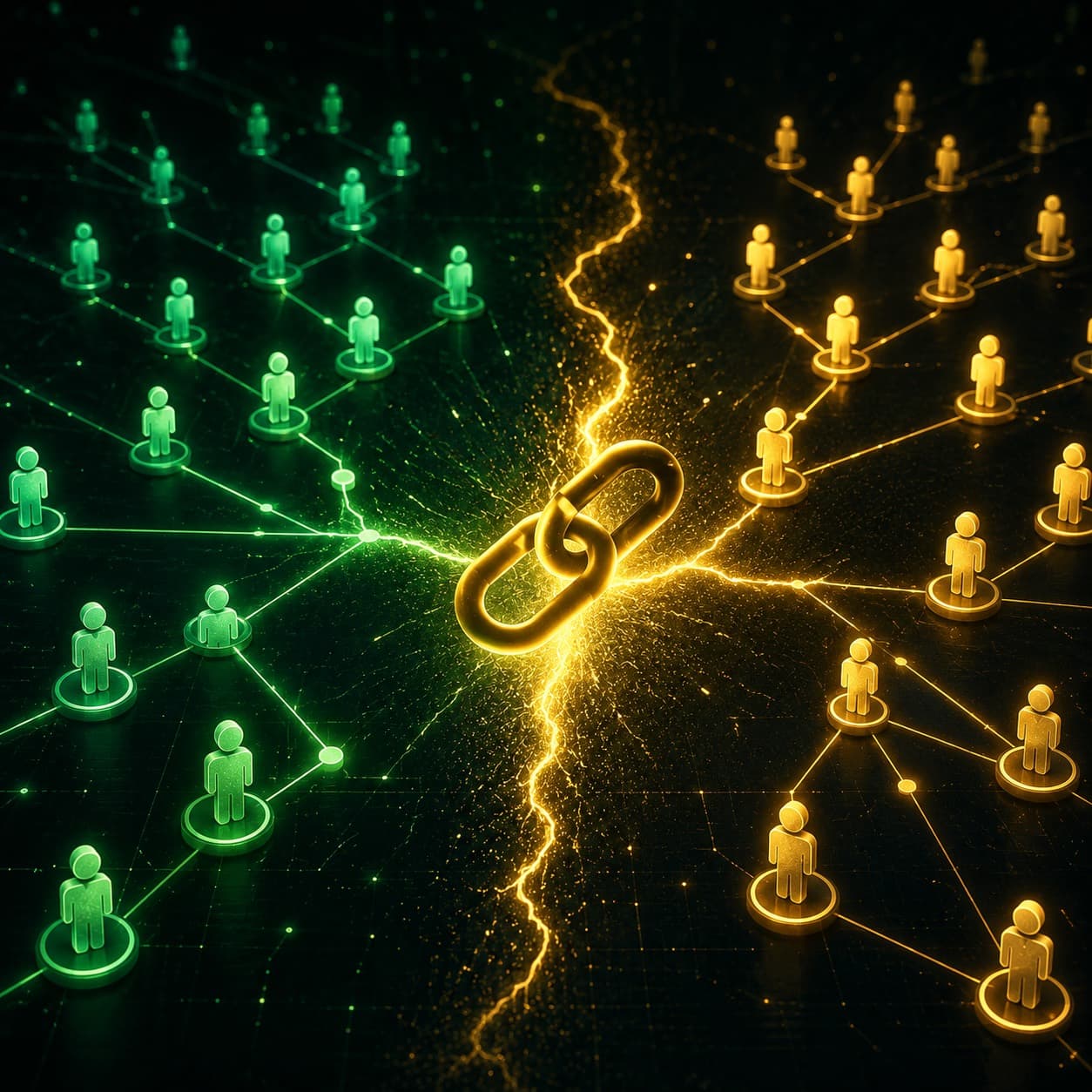
In MagnaFork, an invite link remains useful after a fork split. If the original fork has already completed its cycle, the new participant does not hit a dead end: the contract looks for a live continuation of that fork and routes the entry there.
In short
The consumer meaning is simple: an invite link does not immediately expire when a fork grows and splits.
If a fork reaches the 8/8 condition, the contract executes the cycle payout under the protocol rules and creates two child forks. The old fork no longer accepts entries directly, but a link to it can still work as an entry point into its continuation.
That is useful for the person who has already shared a link. They do not need to explain to every new participant that the old link has "broken." MagnaFork checks where this tree has a live fork with an open seat.
This keeps working after the link's publisher — for example, a major blogger — has already received the payout for their cycle and stopped participating. Previously published posts, videos, QR codes, and messages can keep bringing new entries into child and deeper descendant forks in the same tree.
Important: this is not a payout promise and not a speed guarantee. It is a routing rule. It answers one practical question: where does a person go if they open an invite to a fork that has already split?
What happens after 8/8
A fork moves through its cycle by a visible rule: when the required positions are filled and the outer circle reaches 8/8, the contract completes the cycle.
Three things happen after that:
- the top position receives the smart-contract payout under the rule;
- the original fork receives the
CLOSEDstatus; - two child forks are created and continue the same participation tree.
For a user, this can be explained without technical detail:
The fork does not disappear. It completes one cycle and creates two continuations.
The old fork no longer accepts people directly because its cycle is complete. But the invite to it remains a meaningful link to the same tree. The contract uses that link as a reference point and looks for a live continuation inside that tree.

What "live continuation" means
A live continuation is a fork in the same tree that can still accept an entry.
The contract looks at the current state, not at the story of the link:
- the fork must not be
CLOSED; - it must have an open seat;
- an active fork inside the activity window is preferred first;
- if none is available, a sleeping fork with an open seat can be selected.
This means the user does not need to manually understand which child fork is currently correct. They open the invite, and the contract selects a suitable fork under the routing rules.
If the selected child fork has also split, the route can go deeper into its live continuation. For the user, the meaning stays the same: the old link does not lead to a closed point. It leads to the current available place inside the same tree.
What happens to activity
In MagnaFork, fork activity is maintained by invite entries.
Viewing or opening the link does not change activity. Only a successful on-chain invite entry does, and each such entry updates the fork that the contract actually selected for the participant.
If there is no invite entry for 72 hours, a fork can move to SLEEP. This does not mean the fork disappears. It means the fork stops participating actively in the open route until an invite entry brings it back.
If a person opens an old link and the contract selects a child fork in SLEEP, a successful invite entry moves that selected fork back to ACTIVE.
After the successful entry, the selected fork's last invite time is updated. In practice, the new activity window starts for the live continuation where the participant actually entered.
The old closed fork does not "wake up." It has already completed its cycle and remains CLOSED.
A simple example
Imagine you had fork 12, and you sent its invite link to several people.
Then fork 12 reached the 8/8 condition, completed the cycle, and split into two child forks. Fork 12 itself is now closed, but its continuations keep moving.
A day later, someone opens your old link.
They do not need to find a new one manually. MagnaFork checks the tree of fork 12, finds a suitable live continuation, and routes the entry there.
If the selected continuation was in SLEEP, the invite entry can bring it back to ACTIVE. If it was already active, the entry simply adds the participant to the next open seat and updates that fork's activity window.
For the user, it reads like this:
The link remains usable. The participant lands where the fork can actually continue.
Why this matters to a regular user
A user does not think in contract categories. They think more simply:
- does the link work or not;
- will I land in a clear place;
- will I see the current status;
- do I need to ask for a new link;
- what happens if the old fork has already completed?
Invite routing removes part of that uncertainty.
An old link does not become useless after a split. It remains a way to enter a live continuation of the fork. This matters for posts, QR codes, direct messages, and materials a person has already shared.
The audience of a previously published link can therefore keep supporting child forks after the original cycle ends: consecutive entries can be distributed across suitable descendants, and each entry refreshes the selected fork. Active descendants are preferred over sleeping ones, so neither even distribution nor permanent activity across the whole tree is guaranteed.
But it does not turn participation into a guaranteed outcome. The link helps find the route. The current fork status, open seat, participation level, entry amount, operating fee, and 8/8 rule still matter.
What marketing can say
A good formulation:
An invite link continues to work after a fork split. If the original fork has completed its cycle, MagnaFork routes the new entry into a live continuation of the same tree.
Even simpler:
Your invite does not lead to a dead end. When a fork splits, the link helps find its live continuation.
For FAQ:
What if my fork has already split?
The invite link can continue working as an entry into a live continuation of that fork. If the selected continuation was in SLEEP, a successful invite entry can bring it back to ACTIVE.
What not to say:
- "the link guarantees a payout";
- "activity will always be maintained";
- "any old link always leads to a result";
- "the old fork becomes active again."
The precise wording is: a successful invite entry updates the activity of the selected live fork, not the old closed fork.
What to check before entry
Before confirming a transaction, the user should look at visible conditions instead of promises.
Practical checklist:
- which participation level is selected:
5 / 50 / 500 USDT; - which entry amount will be sent;
- that the operating fee is
7%; - which entry route is selected: invite or Open entry;
- which fork the contract selected for entry;
- whether there is an open seat;
- which activity status is visible;
- whether the
8/8completion rule is clear; - whether you can afford to lose this amount if the cycle does not close.
This list matters more than any advertising text.
MagnaFork is useful not because it promises a hidden result, but because it shows the route and the rules before confirmation.
Conclusion
An invite link after a fork split is not an obsolete link.
It is a reference point for the contract: from which fork it should search for a live continuation.
If the continuation is active, the entry goes there. If the suitable continuation is sleeping, a successful invite entry can bring it back to ACTIVE and update the activity window. If the fork has split again, the route can move deeper through the same tree.
That is how MagnaFork keeps the experience readable for a regular user: the invite remains useful, fork growth does not break the path, and a real entry supports the activity of the fork where the person actually lands.
Disclaimer
This material is educational and is not financial, investment, or legal advice. Participation in MagnaFork involves risk. Routing, activity, payout, and split rules are executed by the smart contract, but the speed of fork filling and the final outcome are not guaranteed. Participate only with an amount you can afford to lose.